



 Jewellery
 View all
 Men
 Women
 Gifts
 Accessories
 Inspiration
A rainy Saturday, a cosy vintage shop, a cognac bag in your hands and one question on your mind: leather vs faux leather? In a product photo the two can look almost identical, and even up close the difference isn't always obvious. With a few simple checks, though, you can usually tell them apart within a minute. Here's how, plus the honest pros and cons of each and how to keep both looking lovely.
In short
How to tell leather from faux leather: 6 simple tests
No single test is foolproof, so combine two or three. The more of them point the same way, the surer you can be.
1. The smell test
Genuine leather has a warm, rich, slightly earthy scent that's very hard to fake. Faux leather smells of plastic or chemicals, or of nothing at all. Hold the piece close and breathe in the inside as well as the outside.
2. Look at the pores and grain
Leather is a natural material, so it carries pores, tiny marks and small shifts in the grain that are never quite the same twice. On faux leather the grain is pressed or printed into the surface, so the pattern looks very even and often repeats. A large, flat area such as the front of a bag is the best place to look.
3. Check the edges
The edges often give the game away. A cut edge of genuine leather looks fibrous, a little like suede, although it's often sealed with edge paint or polished smooth. Faux leather is a plastic layer on a fabric backing, and at a raw edge or inside a seam you can often spot that woven or knitted fabric.
4. Feel the weight and warmth
Leather feels heavier and firmer, and it warms up quickly in your hand. Bend it gently and it forms fine, irregular creases, like the lines on a palm. Faux leather is lighter, often smoother and slightly cooler, and creases more evenly or springs back almost flat.

Shop the look
5. Try the water drop test
Place one small drop of water on a hidden spot. Uncoated leather slowly drinks it in and darkens for a moment, while on faux leather the drop simply beads and rolls away. Many leather wallets and bags have a protective finish, though, so a beading drop doesn't automatically mean it's fake. Dab the spot dry afterwards.
6. Read the label
The quickest check of all. Terms such as 'genuine leather', 'full grain', 'cowhide' or 'nappa' point to real leather. 'PU', 'polyurethane', 'PVC', 'synthetic', 'leatherette' and 'vegan leather' all mean faux leather, even when the word leather appears in the name.
One test to skip: the burn test you'll find online. It damages the item and isn't safe to do at home.
✦Good leather remembers every day you carry it; good faux leather simply lets you travel light.
| Test | Genuine leather | Faux leather |
|---|---|---|
| Smell | Rich and natural | Plastic, chemical or neutral |
| Surface | Irregular pores and small marks | Even, repeating pattern |
| Edge | Fibrous, often painted or polished | Fabric backing visible |
| Weight and feel | Heavier, warms up, fine creases | Lighter, smooth, even creases |
| Water drop | Absorbs slowly (if uncoated) | Beads and rolls off |
| Label | Genuine leather, cowhide, nappa | PU, PVC, synthetic, vegan |
Examples: genuine leather wallets and faux leather bags
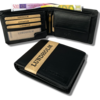
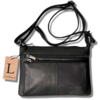
Lundholm sells both, so here are a few pieces to train your eye on. Look closely at the leather and you'll spot the natural grain; the faux leather bags win on lightness and easy cleaning.

Genuine leather: cowhide billfold with RFID

Genuine leather: Arvika pen case
Faux leather: Göta shoulder bag

Shop the look

Faux leather: Göta shoulder bag
Leather vs faux leather: pros and cons
Neither is simply better: it all depends on what you want from your wallet or bag.
| Genuine leather | Faux leather | |
|---|---|---|
| Durability | Very durable, lasts for years with care | Good, but the top layer can crack or peel over time |
| Ageing | Develops a patina and character | Looks the same until it starts to wear |
| Weight | Heavier | Lighter |
| Breathability | Breathes naturally | Breathes less |
| Care | Needs conditioning now and then | Wipe clean, low maintenance |
| Price | Usually higher | Usually lower |
| Animal-free | No | Yes |
For a wallet you'll reach for every day for years, genuine leather is hard to beat: it's sturdy and only grows more characterful with age. For a fashionable bag you'd like to keep light, or if you prefer to avoid animal products, faux leather is a smart choice. Just keep in mind that faux leather is usually made from plastics such as polyurethane or PVC.
✦ Our tip
How to care for leather and faux leather
Caring for genuine leather
- Wipe away dust and dirt with a soft, dry or slightly damp cloth.
- Treat it to a leather balm or conditioner a few times a year to keep it supple.
- Caught in a Dutch downpour? Let it dry naturally at room temperature, never on a radiator or with a hairdryer.
- Store bags in a cotton dust bag, out of direct sunlight.
- Don't overstuff your wallet: it will hold its shape far better.
Caring for faux leather
- Wipe with a damp cloth and a drop of mild soap, then pat dry with a soft towel.
- Skip leather conditioners and oils: they're made for real leather and can leave a greasy film.
- Keep it away from heat and strong sunlight, which can make the top layer brittle.
- Keep sharp keys away from the surface, for example in a leather key case.

Shop the look
Looking for a new wallet? Browse our men's wallets and women's wallets.
Leather or faux leather: find your bag
Shop women's bagsFrequently asked questions
How can you tell if a wallet is real leather?
Check the label first, then look at the edges and smell the wallet. A genuine leather wallet has a fibrous edge, natural grain and a rich smell; a faux leather wallet often shows a fabric backing and smells of plastic or of nothing.
Is PU leather real leather?
No. In everyday use, PU leather means faux leather: a polyurethane coating on a fabric backing. The name is a trade term, so always check the material description.
Is vegan leather the same as faux leather?
Usually, yes. Vegan leather is a trade name for an animal-free material, most often a plastic coating such as polyurethane on a fabric backing, so it is a type of faux leather. Check the material description to see exactly what it is made of.
Does faux leather crack or peel?
Over time, and especially with heat, sunlight or a lot of folding, the top layer of faux leather can crack or peel. Wiping it clean and keeping it away from radiators helps faux leather last longer.
Which lasts longer, leather or faux leather?
With good care, genuine leather generally lasts longer than faux leather and ages more gracefully. Faux leather needs less care but tends to show wear sooner.
Can you use leather conditioner on faux leather?
There's no need. Faux leather doesn't absorb conditioner the way leather does, so a damp cloth with a little mild soap is all a faux leather bag needs.
Read next
Hilten jewellery is sent in a Lundholm gift box with a pouch, ready to give. Free shipping in the Netherlands from €25 and to Belgium and Germany from €50. 14-day returns.


