



 Jewellery
 View all
 Men
 Women
 Gifts
 Accessories
 Inspiration
Picture the 8.12 tram on a wet Monday, everyone pressed shoulder to shoulder, and you suddenly wondering whether an RFID wallet would make that bank card in your pocket any safer. Is it genuine protection from digital pickpockets, or just a clever line on a label? Here's a calm, honest look at how contactless cards work, what RFID blocking does and doesn't do, and when it's worth having.
In short
How contactless cards work
Most bank cards in the Netherlands and Belgium are contactless. Hidden inside each one is a tiny chip wired to an antenna. Hold the card near a payment terminal and the terminal's radio field wakes the chip up, and the two quietly exchange data.
The technology is called RFID, short for radio-frequency identification, and the version used for payments is NFC, or near-field communication. "Near-field" is the key part: contactless payments only work at a distance of a few centimetres, which is why you have to bring your card right up to the terminal. Each payment also uses a one-time code generated by the chip, so data from one transaction can't simply be replayed for the next.
If you've recently moved here, you'll soon notice how card-friendly daily life is. The Dutch even have a verb for paying by card, pinnen, and plenty of cafés and shops are happily card-only. On Dutch trains, trams and buses you can also check in and out by holding your contactless bank card to the reader.
Can someone read your card through your pocket?
In theory, yes. Someone with a portable card reader would need to get within a few centimetres of your card. That is exactly the scene RFID wallets are designed for: a packed train, a bustling market, a snaking queue at the airport.
In practice, the risk is modest. Depending on the card, a reader may pick up the card number and expiry date, but not the security code on the back, and the one-time payment codes make copying a card far from simple. Contactless payments without a PIN are capped at small amounts, and after a few in a row the terminal asks for your PIN anyway.
Banks also keep a watchful eye on unusual activity. So an RFID wallet isn't about fear. Think of it as the second lock on your bike: a small, sensible habit that takes an easy opportunity off the table.
✦ Our tip
What an RFID wallet does and doesn't do
An RFID wallet has a thin shielding layer tucked between its layers. It works like a tiny Faraday cage: radio waves can't get through, so the chip in your card never receives the energy it needs to answer. Here's what that means on an ordinary day.
| Situation | Does an RFID wallet help? |
|---|---|
| Cards in your wallet on a crowded train | Yes. The cards inside can't be read. |
| Paying at a terminal | No. Your card is out of the wallet at that moment. |
| Paying with your phone or smartwatch | No. Your phone relies on its own security, such as your screen lock. |
| Online shopping, phishing e-mails and fake text messages | No. These are about your card details and login codes, not radio signals. |
| A pickpocket takes your whole wallet | No. Block your cards with your bank straight away. |
| Checking in on public transport | Take your card out first, because the reader can't reach it inside the wallet. |

Shop the look
When does an RFID wallet make sense?
RFID protection earns its keep wherever strangers get close to you and your pockets. Think of:
- Travelling. Airports, stations and tourist hotspots are busy, and your attention is already juggling tickets, luggage and directions.
- Crowds. Festivals, Christmas markets, football matches and King's Day, the Dutch national holiday on 27 April when whole cities turn orange.
- Commuting. Rush hour on the train or tram means standing elbow to elbow with strangers, every single working day.
- Carrying several cards. If your wallet holds a debit card, a credit card and perhaps a contactless work pass, blocking keeps them all quiet until you choose one.
That last point comes with a practical bonus. Tap a wallet full of contactless cards against a reader and it may grab the wrong one, a hiccup known as card clash. With an RFID wallet you always take out the one card you actually mean to use.

Shop the look
When is RFID less important? If you mostly pay with your phone and rarely carry a bank card, the benefit is small. In that case, choose your wallet on size, comfort and style, and enjoy RFID as a nice extra rather than a deciding factor.
✦Good security feels a lot like good style: quiet, well made and there when you need it.
RFID wallet or RFID card holder?
Both block in exactly the same way. The real difference is how much you like to carry.
- An RFID billfold wallet suits you if you still carry some cash, receipts and more than a handful of cards. It folds in half and slides into a jacket or back pocket.
- An RFID card holder suits you if you're mostly cashless. It's slim enough for a front pocket, which also happens to be the hardest pocket to pick.
A few more RFID wallets and card holders from the collection:

Idea 01
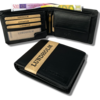
Sundsvall leather billfold
2. Örebro leather card holder

Shop the look

Idea 03
Donsö leather card holder

Idea 04
Hunter card holder with wallet
RFID wallets aren't just for men. The Göteborg leather billfold for women, for example, has RFID blocking too, in a cheerful azure blue that brightens up any handbag.
Wallets with RFID protection
Shop RFID walletsFrequently asked questions
Do RFID-blocking wallets actually work?
Yes, a wallet with a proper RFID-blocking layer stops the contactless cards inside it from being read. You can test an RFID wallet yourself: next time you pay, hold the closed wallet with your card inside against the terminal, and nothing should happen until you take the card out.
Can an RFID wallet damage bank cards?
No. The shielding layer in an RFID wallet only blocks radio signals. It doesn't affect the chip or the magnetic strip, and your bank cards work normally as soon as you take them out.
Can you keep an OV-chipkaart in an RFID wallet?
You can keep an OV-chipkaart in an RFID wallet, but you'll need to take it out to travel. The OV-chipkaart, the Dutch public transport card, also works wirelessly, so the RFID layer blocks it too. Take it out to check in and out, or keep it in a separate pocket.
Does an RFID wallet protect your phone?
No. An RFID wallet only shields the cards inside it. Phone and smartwatch payments are protected by the device's own security, like your screen lock or fingerprint.
Are there RFID wallets for women?
Yes. Several women's wallets and card holders also have RFID blocking, from compact billfolds to wallets with room for plenty of cards. The Göteborg leather billfold in azure blue is a cheerful example of an RFID wallet for women.
Read next
Hilten jewellery is sent in a Lundholm gift box with a pouch, ready to give. Free shipping in the Netherlands from €25 and to Belgium and Germany from €50. 14-day returns.


